


New paper: Contribution of La-Niña-like Pacific Ocean Trend in Sea Surface Temperatures to Western US Wildfire Area, 1984–2022

Our research, Juang et al. (2026), is now published! "Contribution of La-Niña-like Pacific Ocean trend in sea-surface temperatures to western United States wildfire area, 1984-2022", published in Earth's Future.

The tropical Pacific Ocean is home to the leading mode of internal variability globally and has experienced a “La Niña-like” trend with warming in the west and cooling in the east, intensifying the east-west temperature gradient.
This La Niña-like trend has been linked to drying in the Southwest US, but has not yet been assessed for its influence on wildfire.
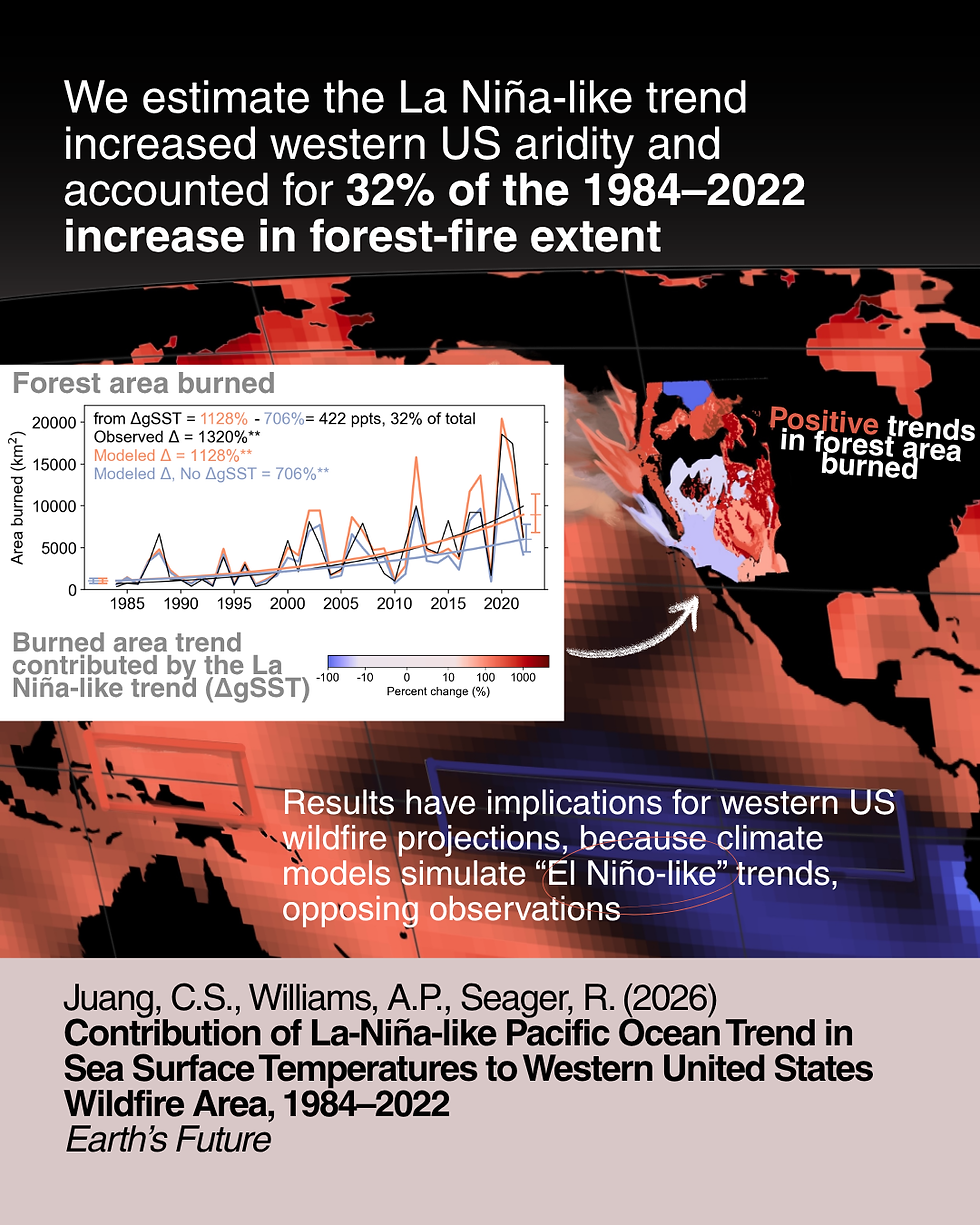
Using statistical models, we estimate that the La Niña-like trend was responsible for one-fifth of the tripling in western US area burned, largely by promoting forest fire.
The intensified tropical Pacific east-west gradient was an important, but non-dominant, contributor to the rapid increases in wildfire area in recent decades.
In contrast to observations, climate models currently simulate that a more “El Niño-like” east-west gradient should arise as part of human-caused climate change. If model projections of continued El Niño-like gSST trends are biased, then inferring future wildfire activity from projected climate will underestimate future burned area trends in fuel-abundant areas. Our work should motivate continued work to understand how the tropical Pacific Ocean and overlying atmosphere are affected by anthropogenic forcing and natural variability.
I created a fun illustration based on the figures in our paper. In the center of the map, I show sea-surface temperature trends (red=warming, blue=cooling). Second, I show the western United States on the map, colored by how the Pacific sea-surface temperature gradient plays a small but important role to western US #wildfire trends (red=increases the burned area trend, blue=decreases the burned area trend).


There’s many people to thank who helped get this research manuscript over the finish line, including my advisor Park Williams and committee member Richard Seager; the anonymous peer reviewers; the journal Editor Kelly Caylor; my labmates, peers, and colleagues; Lamont-Doherty Earth Observatory of Columbia University; my funding from NASA and NSF; colleagues who saw iterations of this work at the AGU Fall Meeting/ the Graduate Climate Conference/ the Pacific Climate Workshop; and my dear friends and family!
Read the paper in AGU Earth's Future.
See my projects page for more on my PhD research on western US wildfires.

Comments